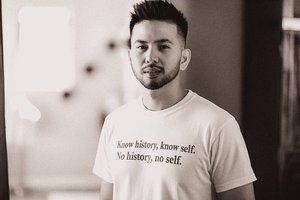
I was five the first time I was close to death, when my grandfather died. Four years later, my mom swooped in from Guam, and together as a family once again, we began our wayward tour of the United States. With each passing day in each new home (we moved from Northern California, to Florida, and Las Vegas), I shed my memories of the motherland like skin. Underneath was a person my childhood friends wouldn't have recognized, and some days I didn't recognize him either.
The day my grandfather died is one of the memories I never lost. He was the only father I ever knew, and losing him so young and so suddenly stayed with me. I remember our family doctor coming to the house the night before he died, and hiding in our family car so I could cry. I remember the mortician bringing him into the guest room at the back of the house to prepare his body, and learning why we had to cover every mirror with a blanket. I remember relatives trickling in from the U.S. day after day, each of them greeting us with sadness, and all of us sitting in the living room around his casket. And I remember watching my mom drop to the floor and scream in terror and disbelief that he was actually gone.
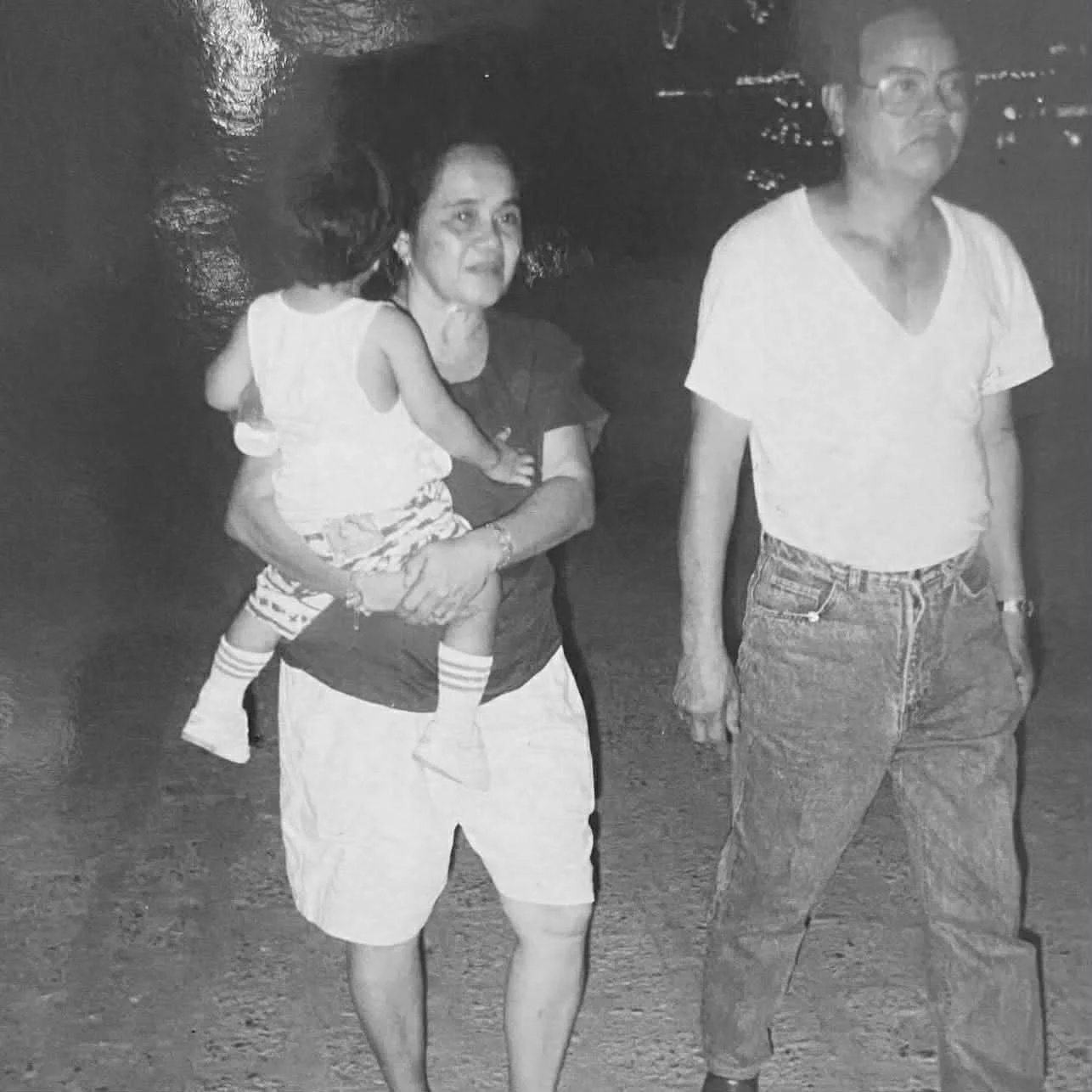
With my grandmother and grandfather at a peria, a town fair, back home in Lubao. I was about three or four.
When I look back on these memories now, it's like watching a movie I'm not in. None of it feels real. I think that's because of all the time that has passed, and the distance it put between me and death.
Earlier this year, death became real again. My grandmother was diagnosed with dementia in 2015. Before her memory truly began to fade, she always talked about going back home to be with my grandfather, and in 2021 we brought her home so that when her day came, they would be together again. This year, as she declined, the family began preparing to gather once more for the day she would pass.
It's heartbreaking to see how much dementia has reduced my grandmother to a shell of who she once was. It had been so long since I'd faced death that the thought of losing her put me in shock, in confusion; I didn't know where to look to prepare myself, so I picked up a book I'd read years ago: Caitlin Doughty's Smoke Gets in Your Eyes. Doughty started working at a crematory in Oakland at 23, and her memoir is about how far Americans have drifted from their own dead. By the 1970s, about two out of three Americans died in a hospital. Home became the most common place to die again only in 2017. Even then, a death in an American family usually ends with a phone call, and the body leaves with strangers.
While we were all back in my childhood home in Lubao, Pampanga, preparing to lose my grandmother, we suddenly lost someone else. I can't claim we had the closest relationship, but after my grandfather, my stepdad was the only other father figure I had growing up. In the days after he died, I learned things about him that I wish I'd known while he was still here. Being back home forced me to learn something else, too, or rather relearn it: how we take care of the dead and how we take care of each other in the face of death.
Helping my stepdad knot his tie on my wedding day, October 15, 2018
How we mourn in Pampanga: Kapampangan wake traditions
Every region of the Philippines marks death a little differently. This is how my family does it in Pampanga.
The wake comes first. In Kapampangan it's the makipaglame, and it runs for at least three days and two nights. Someone stays awake beside the body the whole time. People come in shifts. They bring food, they bring ambag or abuloy, envelopes of cash to help the family with the funeral, and they stay late into the night, eating the dead's favorite foods while friends and family share their most cherished memories of the person they'd just lost.
After the burial comes the pasiyam, nine nights of prayer. Each night ends with something to eat, and the ninth ends with a bigger meal to thank everyone who kept coming back. On the fortieth day, the family gathers again. The belief is that by then the soul has finished wandering and gone home.
The last marker comes a year later. Families in mourning used to wear black for twelve months, the women especially. Tagalog families call the first death anniversary babang luksa, the descent from mourning. In Pampanga we call it lukas paldas, the removing of the mourning dress: a big meal, with the pangadi, the prayers, at the center of it.
The philosopher Byung-Chul Han argues that modern life has lost its rituals of closure, the thresholds that tell us one part of life has ended and another has begun. Lukas paldas is one of those thresholds. In a few months' time, my family and I will go back home to mark the first anniversary of my stepdad's death, and the end of our mourning.
The rules nobody explains: Filipino funeral superstitions
Children at a Filipino wake learn the rules long before anyone explains them. You don't sweep while the body is in the house, or you'll sweep the spirit out with the dust. On the day of the burial, before the casket closes, the youngest children are passed under it so the dead won't come back to visit them. The rosary in the casket gets broken so death doesn't keep moving through the family. The family never walks guests to the door.
And when you leave a wake, you don't go straight home. You stop somewhere first, a convenience store, a mall, a relative's house, so that whatever spirit or entity that follows you on your way home loses your trail. That's pagpag, from the word for shaking off dust. When we buried my stepdad, we stopped at a chapel just down the street from the cemetery to say a prayer and to dust death off us.
Before the friars: precolonial Filipino burial practices
Many Filipino death rituals are older than the Church that eventually blessed them. Long before the Spanish arrived, people across the islands had their own ways of caring for their dead, and the oldest evidence goes back nearly 3,000 years.
The best-known example sits in the National Museum of Anthropology in Manila. The Manunggul Jar was excavated in 1964 from a cave in Palawan and dates to around 890–710 BCE. It was made for a secondary burial: the body was left to decompose, and the bones were later gathered and laid to rest inside the jar. On its lid, two figures sit in a boat, souls paddling toward the afterlife.
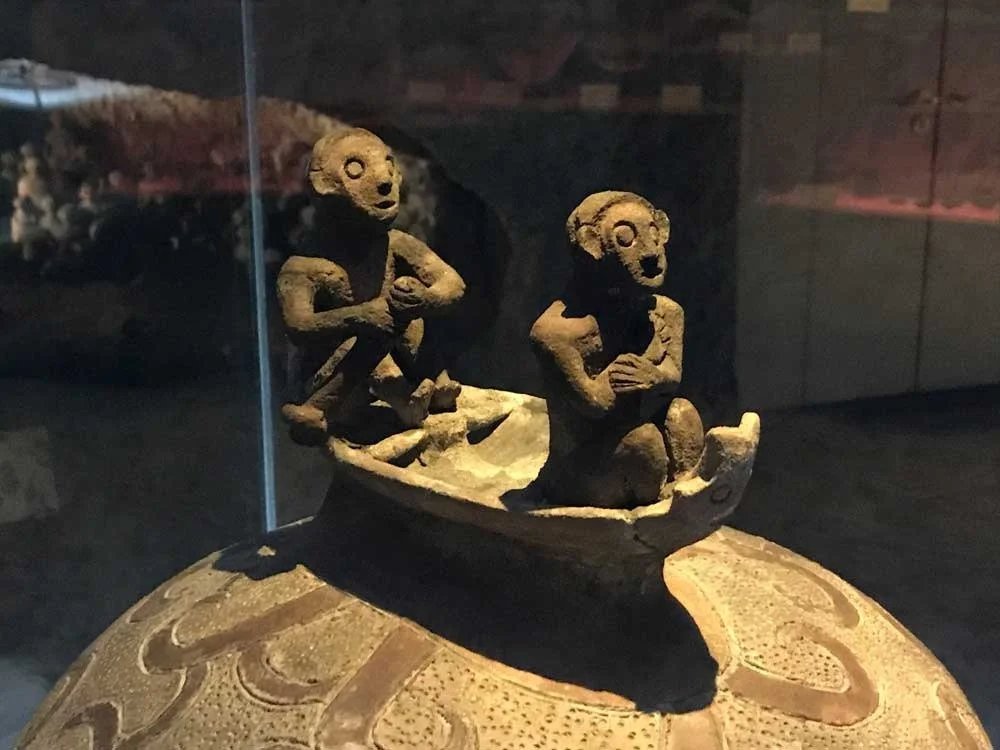
The lid of the Manunggul Jar, c. 890–710 BCE: two souls paddling toward the afterlife. National Museum of Anthropology, Manila.
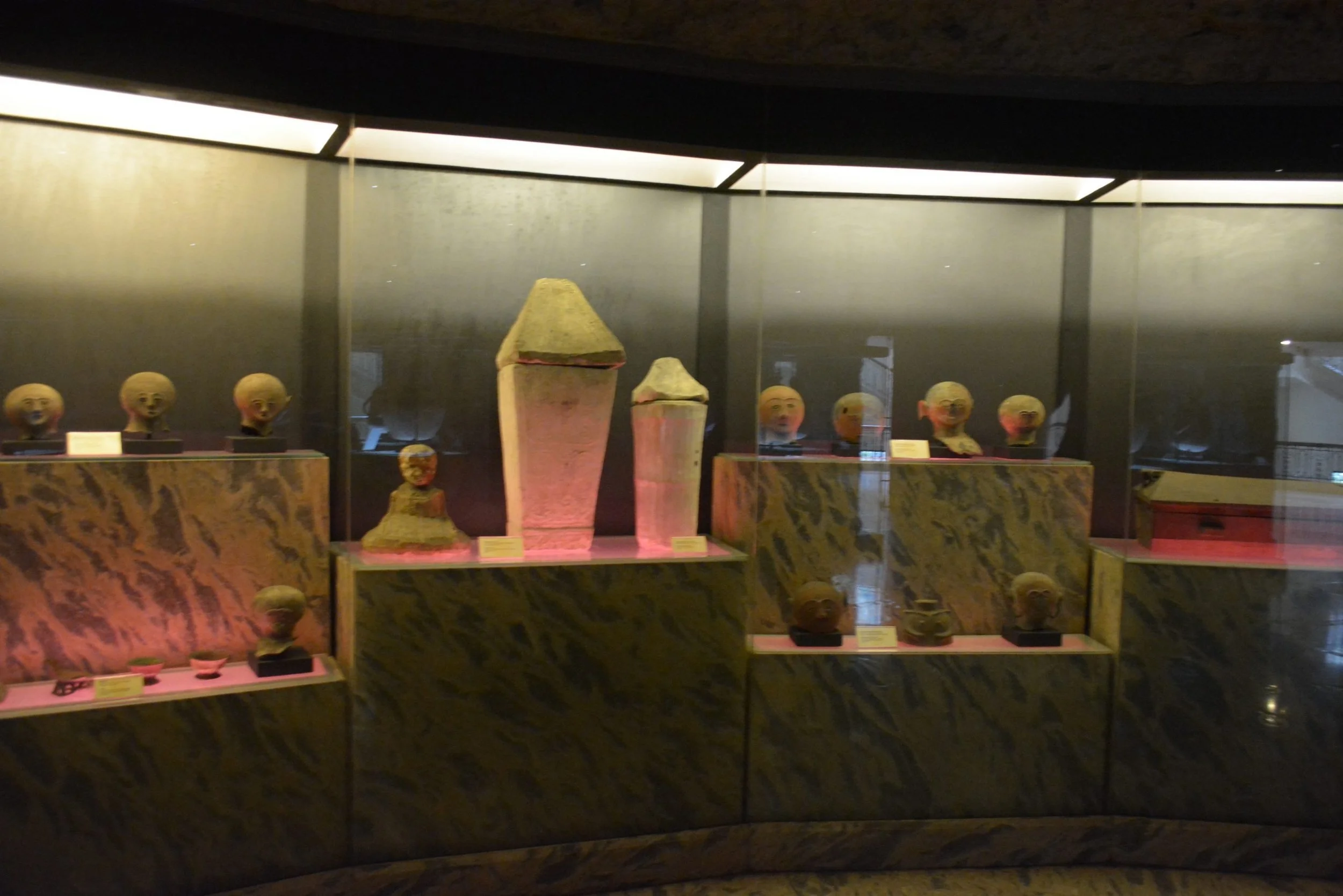
Burial jars and head-shaped jar covers in the Kaban ng Lahi gallery, National Museum of Anthropology, Manila.
In the same gallery are jars from the other end of the country. In 1991, National Museum archaeologists recovered 29 burial jars from a cave in Maitum, Sarangani, their lids shaped like human heads. They date to roughly 5 BCE to 355 CE, and nothing like them has been found anywhere else in the Philippines or in Asia.
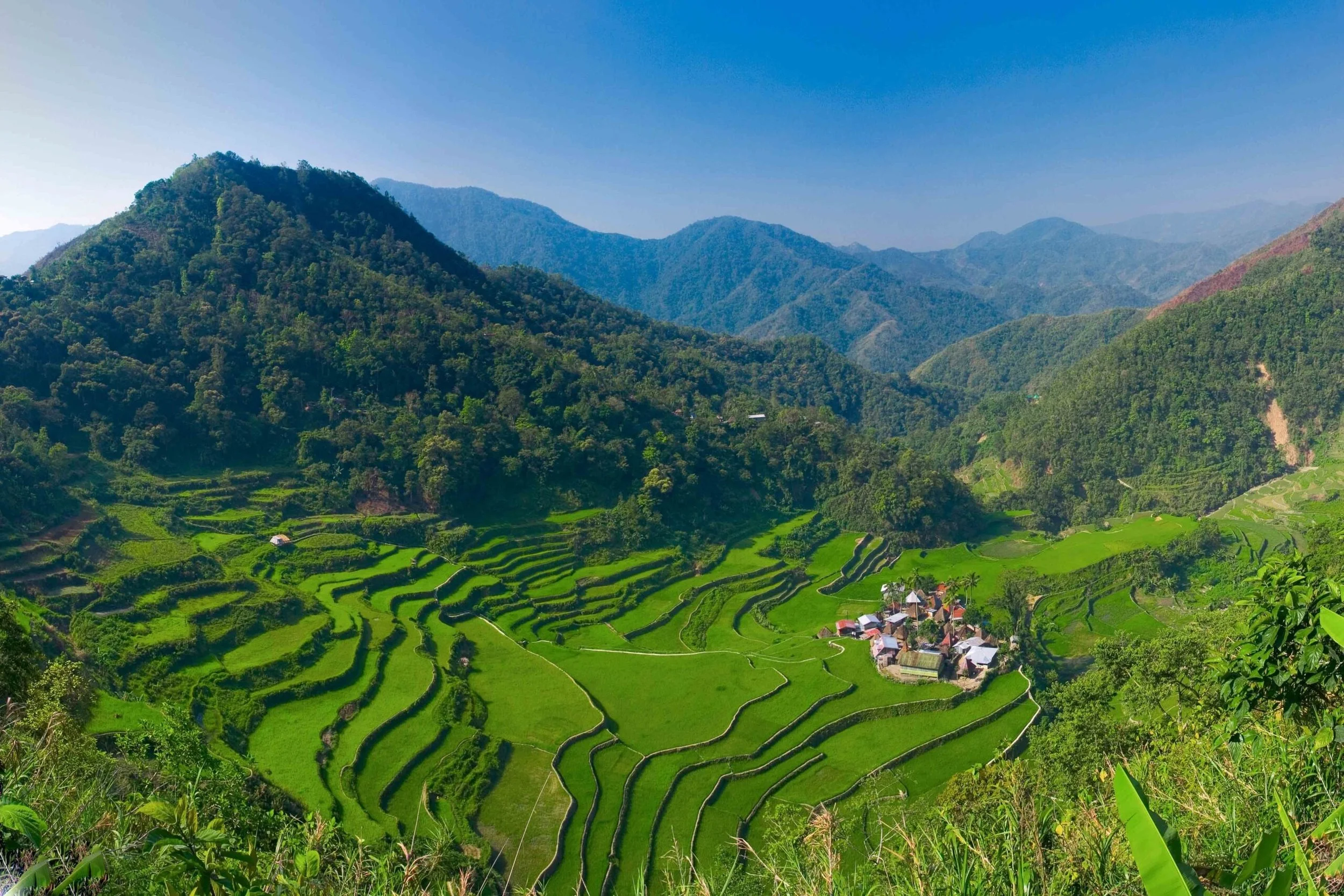
Rice terraces in the mountains of northern Luzon.
In the mountains of northern Luzon, burial traditions are still part of living memory. Between about 1200 and 1500 CE, the Ibaloi of Kabayan, Benguet preserved some of their dead with fire. The dying were given a heavy salt drink, and after death the body was washed, seated over a low fire and smoked dry, a process that could take weeks or months. Farther north in Sagada, the Kankanaey hung coffins from the cliffs of Echo Valley, an honor reserved for respected leaders and placed high to bring the dead closer to their ancestors.
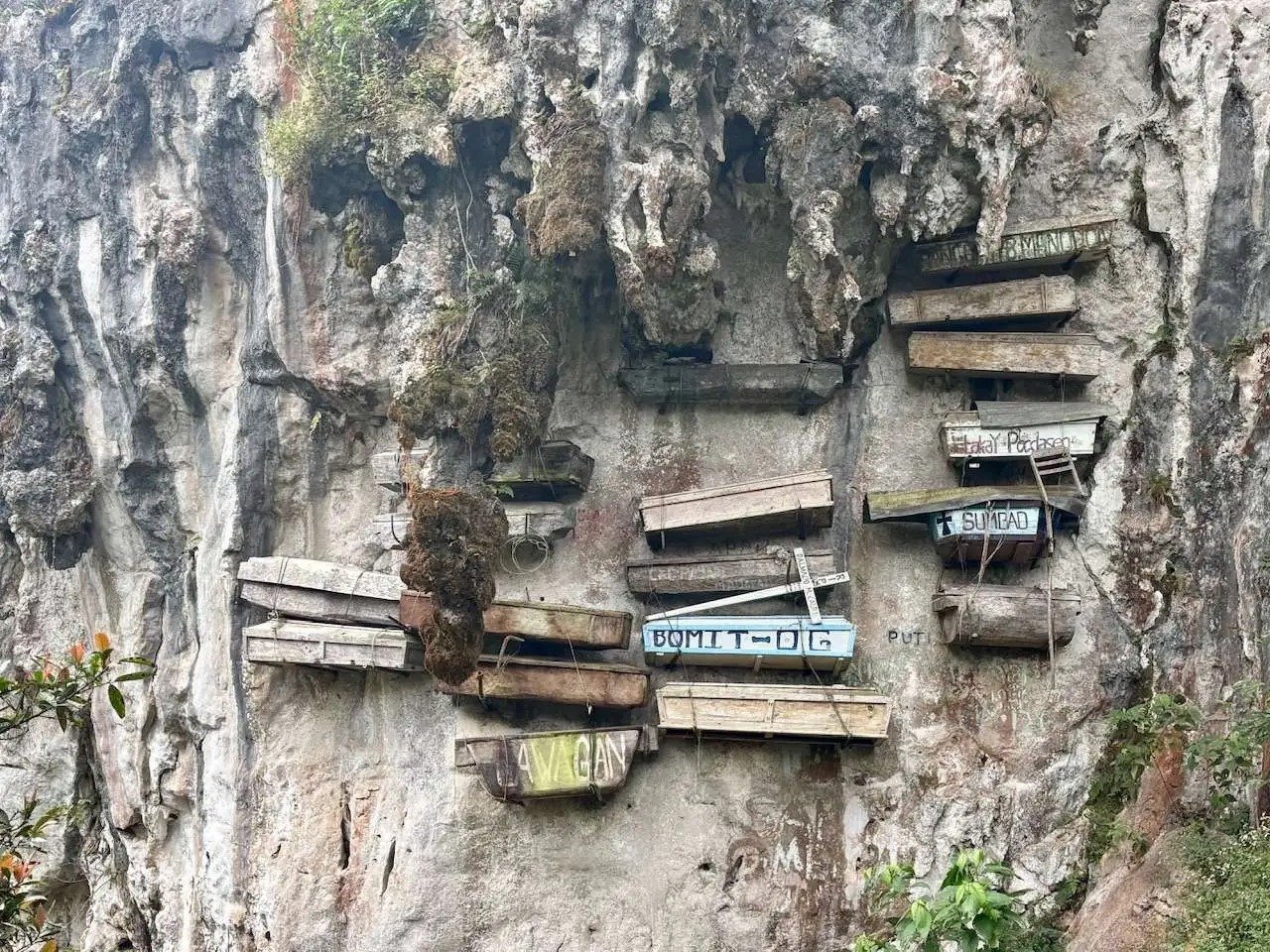
Hanging coffins on the cliffs of Echo Valley, Sagada, Mountain Province.
To the Ibaloi and Kankanaey, the people in those caves and coffins are ancestors, and they're treated that way. Families in Kabayan still bring them offerings, and the most recent cliff burial in Sagada took place in 2010.
Pampanga has a buried history of its own. In 1959, the anthropologist Robert Fox excavated a cemetery in Porac with 300 graves dating to around 1200 CE, including a jar that held a child's bones and bangles. The settlement there left behind Chinese and Vietnamese trade ceramics, proof of trade across the sea centuries before the Spanish arrived in 1571. In Lubao, my hometown, archaeologists have dated a site in Barangay Remedios to about 600 to 700 years ago.
Across these communities, the dead didn't simply leave. Many became anito, ancestral spirits the living kept honoring with prayers, chants and offerings, in rituals often led by the babaylan, the spiritual leaders and healers of their communities.
Syncretism as survival
When the Spanish arrived, the friars set out to replace all of it. What happened instead is what scholars call syncretism: the old beliefs moved inside the new religion and kept going. The anito became the saints, and prayers to the ancestors became prayers for the souls. Nestor Castro, an anthropologist at UP Diliman, traces several of today's customs back before the Spanish. The all-night wake was kept to stop an aswang from taking the body. The food families bring to the cemetery continues the Ilocano pag-aatang, setting food aside for the dead. And pangangaluluwa, going house to house singing for the souls, is older than the friars too.
I used to think of this as a loss, our own rituals buried under someone else's. Being home in February changed my mind. Our ancestors kept what they could by folding it into the rituals they were made to adopt. That's how a family in Lubao can stop at a Catholic chapel after a burial to pray and shake death off in the same breath.
Undas in Pampanga
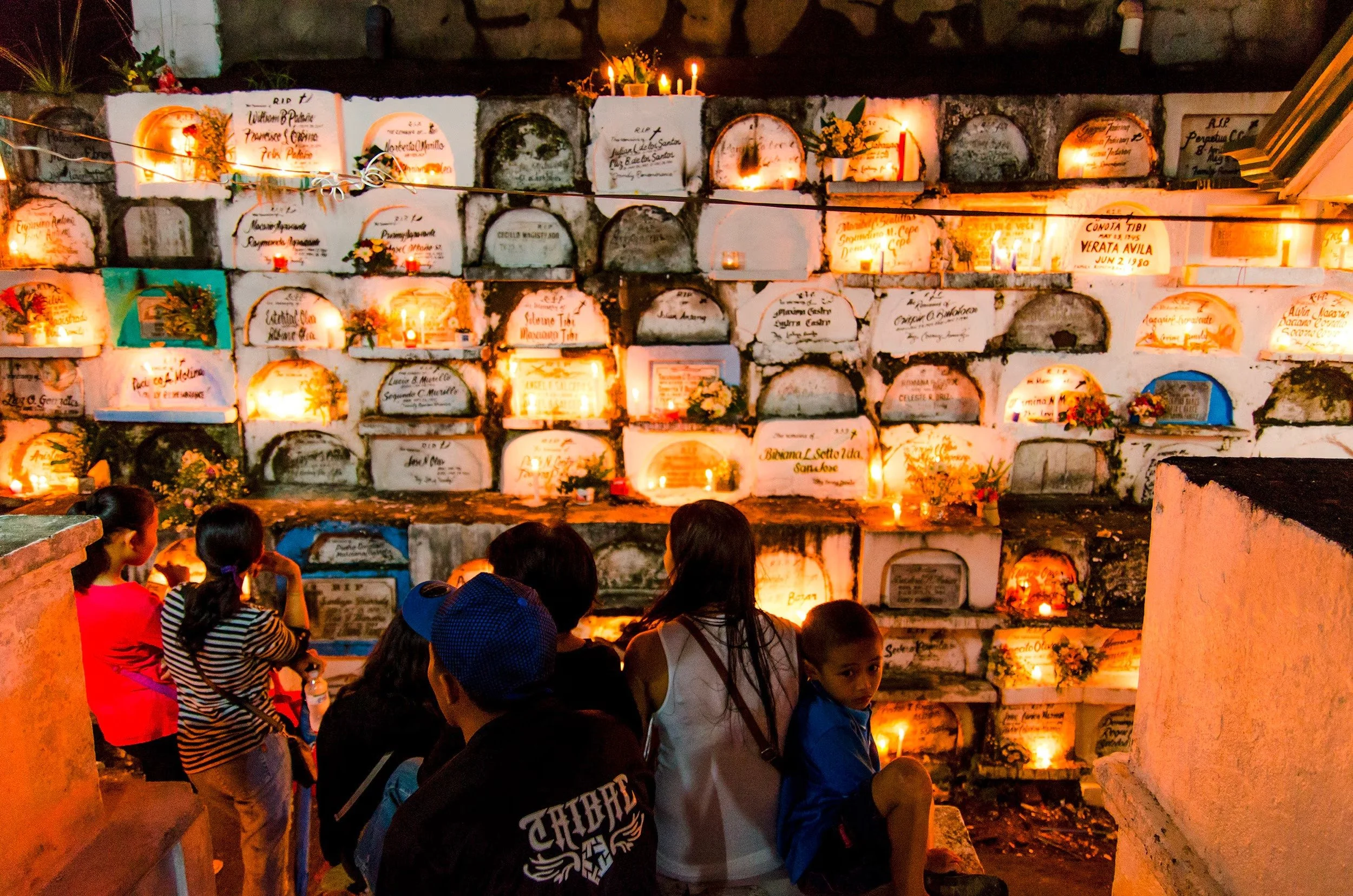
Families keep vigil at candlelit tombs during Undas.
On the 1st and 2nd of November, the whole country goes to the cemetery. Families clean the graves, light candles and stay into the night, eating and talking so the dead have company. In Pampanga the season is called daun, and for generations it also had a sound.
In the weeks before Undas, groups of singers called maggogosu went house to house singing the gosu, hymns and prayers for the saints and the souls. They sent letters ahead to say when they would come, sang in everyday clothes, and accepted whatever a household could share: money, food, candles for the dead. Each song closed with a prayer that the souls of the faithful rest in peace.
The gosu was already fading before the pandemic, and COVID stopped it in many villages because most of the singers were elderly. Since 2022 it has come back to villages in Mexico, Masantol, Arayat and Guagua. In Barangay San Antonio in Mexico, the choir told the Inquirer they kept singing because the gosu was a vow to their dearly departed. The Center for Kapampangan Studies at Holy Angel University published composer Cris Cadiang's collection Gale at Gosu, and he has given anyone permission to sing the 175 gosu he wrote.
The hymns came with the friars, but by Castro's account, going door to door for the dead was already here.
Never alone with it
In her book, Doughty argues that keeping death at a distance makes grief harder to get through. In Filipino culture, we keep death close through our rituals. When my stepdad died, there was never a moment when we were alone with it. There was always a member of the family, a friend, or a neighbor nearby to make sure we were okay.
His death also changed who takes care of whom in our family. I'll write about that next.
Tell us how your family remembers. If this brought back rituals from your own home, from Pampanga or anywhere else, we want to hear them. Message us at @diwamag or write to stories@diwamag.co.
Get the next story in your inbox.